# Venus
Venus is the second planet from the Sun and Earth's closest planetary neighbor ([NASA Venus facts](https://science.nasa.gov/venus/facts/)). It is a terrestrial planet with no natural satellites and no ring system ([NSSDCA Venus Fact Sheet](https://nssdc.gsfc.nasa.gov/planetary/factsheet/venusfact.html), last updated 11 January 2024). The same fact sheet lists the discoverer as unknown and the discovery date as prehistoric, so those fields are left empty here. NASA names Venus for the ancient Roman goddess of love and beauty and notes that it is the only planet named after a female deity.
## Basic facts
Unless noted, the figures in this section are from the NSSDCA Venus Fact Sheet.
The volumetric mean radius is 6,051.8 km (equatorial and polar radii are both 6,051.8 km). The mass is 4.8673 × 10²⁴ kg, or 0.815 of Earth's. The mean density is 5,243 kg/m³. Mean surface gravity is 8.87 m/s², and the escape velocity is 10.36 km/s. The Bond albedo is 0.77 and the geometric albedo is 0.689.
The J2000 mean semimajor axis is 0.72333199 au, or 108.210 million km. The sidereal orbital period is 224.701 days; the tropical orbital period is 224.695 days. Perihelion is 107.480 million km and aphelion is 108.941 million km. The orbital eccentricity is 0.0068 and the inclination to the ecliptic is 3.395°. The mean orbital speed is 35.02 km/s.
The sidereal rotation period is −5,832.6 hours; the negative sign denotes retrograde rotation. The length of a solar day is 2,802.0 hours. The obliquity to the orbit is 177.36°. [NASA](https://science.nasa.gov/venus/facts/) notes that Venus spins slowly in the direction opposite to most planets.
The atmosphere is dense. Surface pressure is 92 bars, the average temperature is 737 K (464 °C), and the diurnal temperature range is approximately zero. Near the surface the atmosphere is 96.5% carbon dioxide and 3.5% nitrogen by volume, with minor sulfur dioxide (150 ppm), argon (70 ppm), and water (20 ppm). NASA describes a runaway greenhouse effect that makes Venus the hottest planet in the solar system, with surface temperatures it gives as about 467 °C (872 °F), hot enough to melt lead, and a surface pressure about 93 times that at sea level on Earth. NASA also reports that about 50 km above the surface, temperatures range from 30 to 70 °C at a pressure similar to Earth's surface, and that winds at the cloud tops have been measured as high as 360 km/h.
## Image
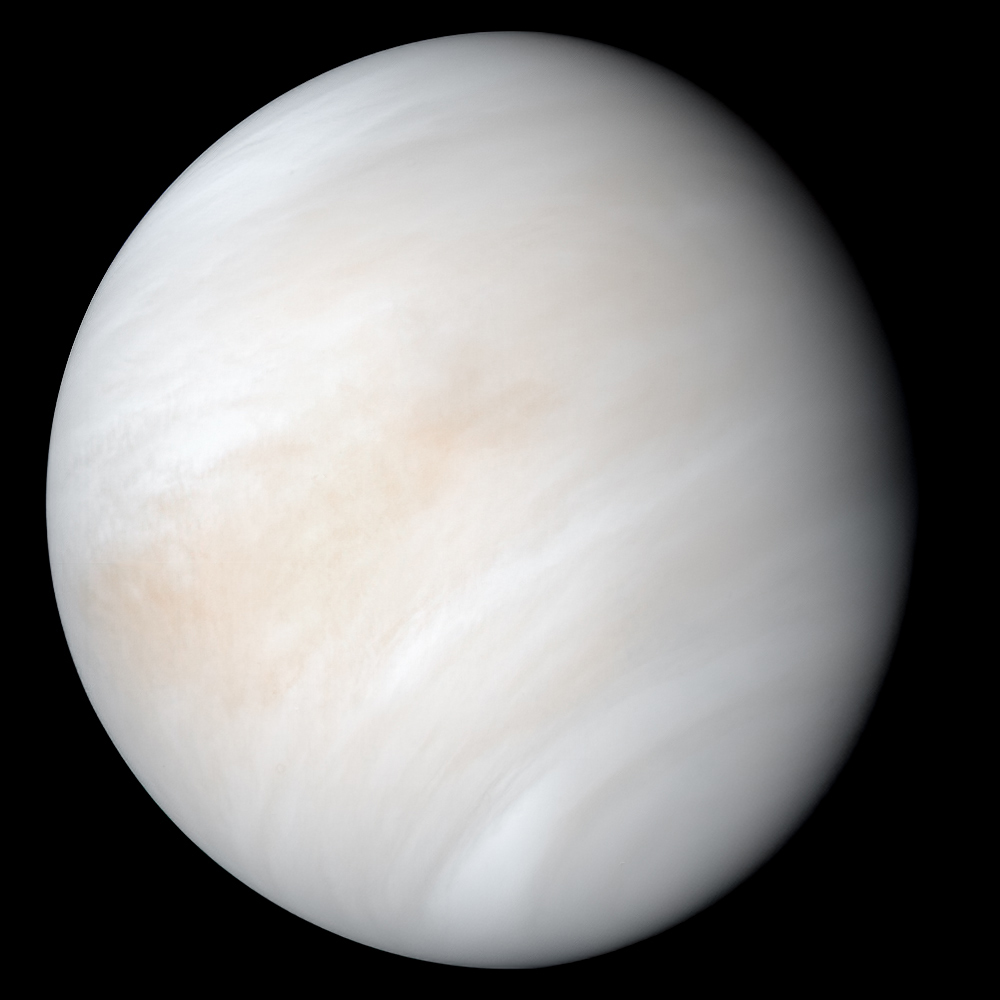
As it sped away from Venus in February 1974, Mariner 10 captured this view of the planet's dense, global cloud layer. Credit: NASA/JPL-Caltech. License: public domain (NASA). Source: [Wikimedia Commons](https://commons.wikimedia.org/wiki/File:Venus_from_Mariner_10.jpg), which cites the NASA page [Newly Processed Views of Venus from Mariner 10](https://solarsystem.nasa.gov/resources/2524/newly-processed-views-of-venus-from-mariner-10/). The JPEG URL above returned HTTP 200 (`image/jpeg`) when checked on 14 November 2026.
## Missions and observations
Many spacecraft have visited Venus. This section covers three milestone NASA missions, and it is not a complete list; for that reason `missions_count` is left empty.
- **Mariner 2** (NASA) — launched 27 August 1962 on an Atlas-Agena B. It was the first spacecraft to successfully encounter another planet. It passed Venus at a closest distance of 34,773 km at 19:59:28 UT on 14 December 1962, and returned data on the planet's atmosphere, magnetic field, and charged-particle environment ([NSSDCA Mariner 2](https://nssdc.gsfc.nasa.gov/nmc/spacecraft/display.action?id=1962-041A)).
- **Pioneer Venus Orbiter** (NASA) — launched 20 May 1978 and inserted into Venus orbit on 4 December 1978 at 15:58 UT. Its periapsis was held between 142 and 253 km until July 1980. In May 1992 it began a final phase in which periapsis was held between 150 and 250 km until its fuel ran out and atmospheric entry destroyed it. The last transmission was received at 19:22 UT on 8 October 1992 ([NSSDCA Pioneer Venus Orbiter](https://nssdc.gsfc.nasa.gov/nmc/spacecraft/display.action?id=1978-051A)).
- **Magellan** (NASA/JPL) — launched 4 May 1989 at 18:47 UT from Space Shuttle Atlantis (STS-30R), the first deep-space probe launched by a space shuttle. It arrived in Venus orbit on 10 August 1990 and was the first spacecraft to image the entire surface of Venus. Its first radar mapping cycle ended on 15 May 1991 with 83.7% of the surface imaged, the second on 15 January 1992 (96%), and the third, focused on stereo imaging, on 13 September 1992 (98%). Contact was lost on 13 October 1994 after Magellan was commanded to plunge into Venus's atmosphere ([NASA Magellan](https://science.nasa.gov/mission/magellan/)).
## In books and media
Only works checked against a publisher or official page are listed.
- Stephen W. Bougher, Donald M. Hunten, and Roger J. Phillips, eds., *Venus II: Geology, Geophysics, Atmosphere, and Solar Wind Environment*, University of Arizona Press (Space Science Series), 1,362 pages; the publisher lists the ebook as published February 2022. Publisher page: [University of Arizona Press](https://uapress.arizona.edu/book/venus-ii).
## See also
[[Solar System Objects]]