# Triton
Triton is the largest of Neptune's moons and the only large moon in the solar system on a retrograde orbit. Scientists think it is a Kuiper Belt object captured by Neptune's gravity ([NASA](https://science.nasa.gov/neptune/moons/triton/)). British astronomer William Lassell discovered it on 10 October 1846, 17 days after Neptune itself (NASA).
## Basic facts
From the NASA/NSSDCA Neptunian Satellite Fact Sheet ([NSSDCA](https://nssdc.gsfc.nasa.gov/planetary/factsheet/neptuniansatfact.html)): mass 214 × 10²⁰ kg (2.14 × 10²² kg), radius 1,353.4 km, mean density 2,050 kg/m³ and visual geometric albedo 0.72. It orbits Neptune at a semimajor axis of 354.76 × 10³ km (14.328 Neptune radii) with a retrograde period of 5.876854 days (recorded here as a positive number), eccentricity 0.000016 and inclination 157.345°; the sheet marks its rotation as synchronous. The page records the semimajor axis in au, converted from kilometres using 1 au = 149,597,870.7 km, and the rotation period as the orbital period × 24 (141.0445 hours) because the rotation is synchronous.
## Image
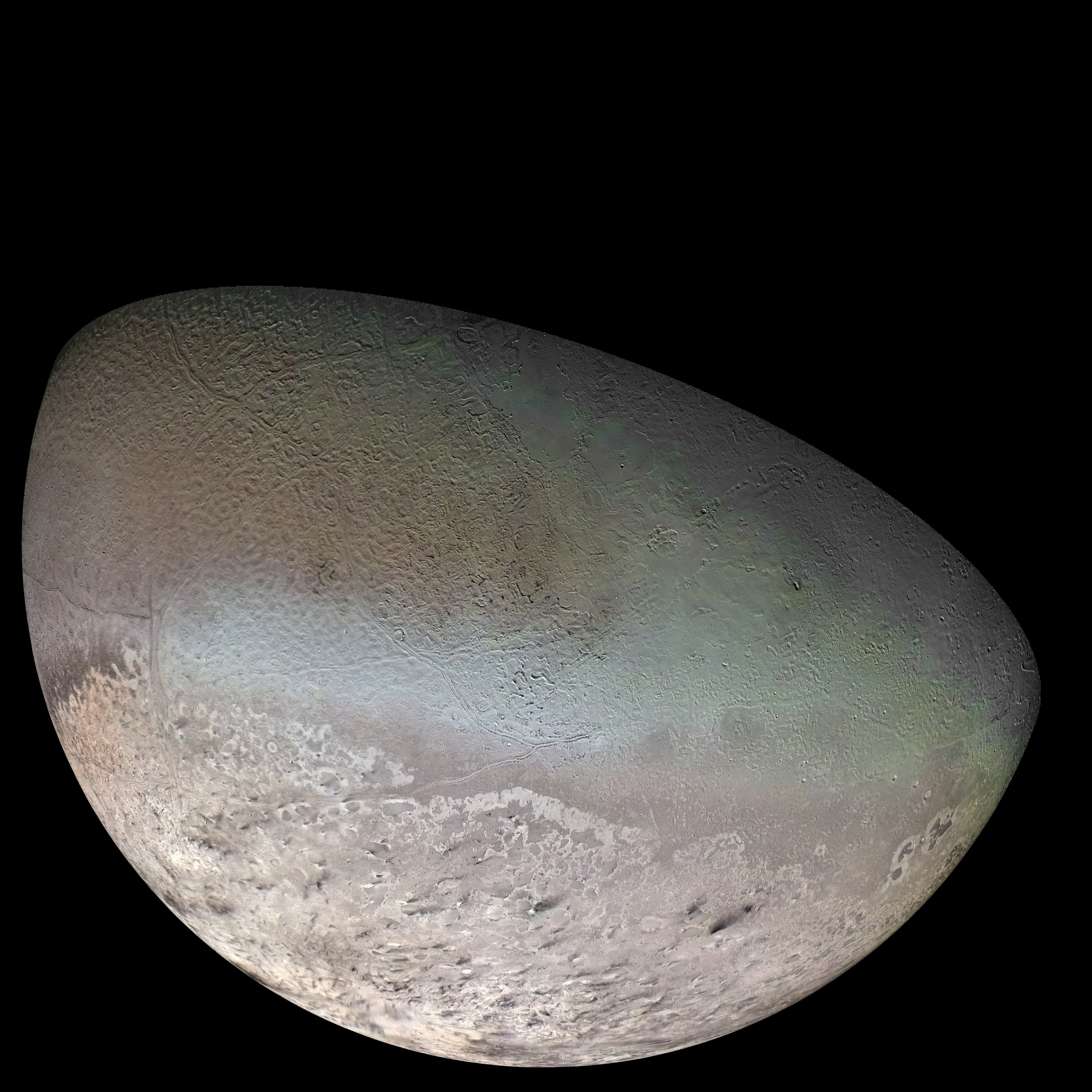
Global color mosaic of Triton taken by Voyager 2 in 1989. Credit: NASA/Jet Propulsion Laboratory/U.S. Geological Survey. License: Public domain (NASA/JPL/USGS) (per Wikimedia Commons). Source: [Wikimedia Commons](https://commons.wikimedia.org/wiki/File:Triton_moon_mosaic_Voyager_2_(large).jpg).
## Missions and observations
`missions_count` is left empty because no authoritative total was checked; the list below is not claimed to be complete.
- **Voyager 2** — the only spacecraft to fly past Neptune and Triton; its 1989 flyby measured surface temperatures of about −235 °C and found active geysers ([NASA](https://science.nasa.gov/neptune/moons/triton/)). The mosaic above is dated 25 August 1989 on Commons.
## In books and media
No books, films or documentaries have been verified for this page.
## See also
[[Neptune]] · [[Pluto]] · [[Solar System Objects]]