# Sputnik 1
Sputnik 1 was the first artificial satellite successfully placed in orbit around the Earth ([archived NSSDCA Sputnik 1, 1957-001B](https://web.archive.org/web/20210128235046/https://nssdc.gsfc.nasa.gov/nmc/spacecraft/display.action?id=1957-001B); [NASA, Dawn of the Space Age](https://www.nasa.gov/history/dawn-of-the-space-age/)). It is not still in orbit. NASA and NSSDCA date the satellite's atmospheric reentry to 4 January 1958; the R-7 core stage that also reached orbit reentered earlier, on 1 December 1957 ([NASA, 65 Years Ago: Sputnik Ushers in the Space Age](https://www.nasa.gov/history/65-years-ago-sputnik-ushers-in-the-space-age/); [HEASARC timeline](https://heasarc.gsfc.nasa.gov/docs/heasarc/headates/1900.html); archived NSSDCA). The official Russian name, *Sputnik*, means "companion," or "satellite" in the astronomical sense (NSSDCA; [ESA, Integral launch campaign, 4 October 2002](https://sci.esa.int/web/integral/-/31644-launch-campaign)). Alternate designations include PS-1 (Simple Satellite No. 1, or Preliminary Satellite 1), 1957 Alpha 2, and NORAD catalog number 00002 (NSSDCA; [Siddiqi, "Korolev, Sputnik, and The International Geophysical Year"](https://www.nasa.gov/history/sputnik/siddiqi.html)).
The live [NSSDCA Master Catalog page for 1957-001B](https://nssdc.gsfc.nasa.gov/nmc/spacecraft/display.action?id=1957-001B) returned an error when checked on 14 November 2026. Facts below that are cited to NSSDCA come from a Wayback Machine capture of that same catalog record, archived 28 January 2021.
## Design
The satellite began as a simpler substitute for a heavier scientific spacecraft, Object D, after that project fell behind and the R-7's engines produced less specific impulse than planned. On 15 February 1957 the USSR Council of Ministers approved two "simple satellites," PS-1 and PS-2. PS-1 was designed and built at Sergei P. Korolev's Experimental Design Bureau No. 1 (OKB-1), with batteries from the Scientific Research Institute of Current Sources and radio transmitters from NII-885. Mikhail S. Khomyakov was lead designer; Oleg G. Ivanovskiy was his deputy ([Siddiqi](https://www.nasa.gov/history/sputnik/siddiqi.html)).
The finished spacecraft was a pressurized sphere 58.0 cm in diameter, made of an aluminum alloy, formed from two hemispheres. Its mass was 83.6 kg, of which 51.0 kg was the power source: three silver-zinc batteries. The interior was filled with nitrogen at 1.3 atmospheres and held the batteries, two D-200 radio transmitters, a DTK-34 thermo-regulation system, a ventilation system, temperature and pressure transmitters, and wiring. Four rod antennas were attached, two 2.4 m long and two 2.9 m long. The transmitters operated at 20.005 and 40.002 MHz (wavelengths of about 15 m and 7.5 m). Siddiqi describes the signals as spurts lasting 0.2 to 0.6 seconds; NSSDCA describes alternating groups 0.3 s in duration. Those transmissions produced the well-known "beep-beep" ([Siddiqi](https://www.nasa.gov/history/sputnik/siddiqi.html); archived NSSDCA). ESA, writing from Baikonur on the 45th anniversary of the launch, added that the batteries were sufficient to provide one watt of power for up to three weeks ([ESA, Integral launch campaign](https://sci.esa.int/web/integral/-/31644-launch-campaign)).
NASA's 65th-anniversary history states that Sputnik itself carried no scientific instruments, only a transmitter. NSSDCA notes that the mission still yielded data on upper-atmosphere density and on radio-signal propagation in the ionosphere, that the downlink included temperatures inside and on the surface of the sphere, and that, because the sphere was nitrogen-filled, a loss of internal pressure would have been evidence of meteoroid penetration; no such events were reported ([NASA, 65 Years Ago](https://www.nasa.gov/history/65-years-ago-sputnik-ushers-in-the-space-age/); archived NSSDCA). Siddiqi lists the five primary objectives as testing the method of placing a satellite in Earth orbit, estimating atmospheric density from the lifetime in orbit, testing radio and optical tracking, studying radio-wave propagation through the atmosphere, and checking the satellite's pressurization ([Siddiqi](https://www.nasa.gov/history/sputnik/siddiqi.html)).
## Launch
Sputnik 1 was launched on 4 October 1957 from the Tyuratam site in Kazakhstan, then part of the Soviet Union, now known as the Baikonur Cosmodrome. NSSDCA locates the pad at Tyuratam, 370 km southwest of the small town of Baikonur. Siddiqi gives the lift-off time as 22:28:34 Moscow Time; ESA gives 22:28 Moscow Time (archived NSSDCA; [Siddiqi](https://www.nasa.gov/history/sputnik/siddiqi.html); [ESA, Integral launch campaign](https://sci.esa.int/web/integral/-/31644-launch-campaign); [NASA, 65 Years Ago](https://www.nasa.gov/history/65-years-ago-sputnik-ushers-in-the-space-age/)).
The launch vehicle was a modified R-7 intercontinental ballistic missile, designated 8K71PS by Siddiqi and listed by NSSDCA as a modified SS-6 (Sapwood), the NATO reporting name for the R-7. According to Siddiqi, the fueled booster mass was 272,830 kg and the five engines generated about 398 tons of thrust at launch. There were problems during ascent, including higher than normal kerosene consumption after a tank-emptying system failed at T+16 seconds, and main-engine cut-off one second earlier than planned. Separation from the core stage occurred successfully at T+324.5 seconds, and the 83.6 kg satellite entered an elliptical Earth orbit ([Siddiqi](https://www.nasa.gov/history/sputnik/siddiqi.html); archived NSSDCA).
The core stage also reached orbit. Because it was large and reflective, most visual observers saw the booster rather than the much smaller satellite. NSSDCA describes the booster as a first-magnitude object at night, while the highly polished sphere was only about sixth magnitude ([NASA, 65 Years Ago](https://www.nasa.gov/history/65-years-ago-sputnik-ushers-in-the-space-age/); archived NSSDCA).
## Orbit and radio signal
After insertion, ballistics specialists at the Coordination-Computation Center in Moscow determined an orbit of 228 km by 947 km, inclined 65.6° to the equator, with a period of 96.17 minutes; the apogee was about 80 km lower than planned because of the early engine cut-off ([Siddiqi](https://www.nasa.gov/history/sputnik/siddiqi.html)). ESA independently gives the same perigee and apogee, an inclination of 65.1°, and a first-orbit period of 96 minutes 10.2 seconds (96.17 minutes) ([ESA, Integral launch campaign](https://sci.esa.int/web/integral/-/31644-launch-campaign)). NSSDCA also records an apogee of 947 km after launch, declining to 600 km by 9 December. NASA's Dawn of the Space Age page rounds the period to about 98 minutes ([NASA, Dawn of the Space Age](https://www.nasa.gov/history/dawn-of-the-space-age/); archived NSSDCA).
The "beep-beep" radio signal was received around the world, including by amateur operators, and was used to confirm that the satellite had reached orbit. Korolev waited for the signal after the first complete revolution before treating insertion as confirmed ([Siddiqi](https://www.nasa.gov/history/sputnik/siddiqi.html); [NASA, 65 Years Ago](https://www.nasa.gov/history/65-years-ago-sputnik-ushers-in-the-space-age/)). The official Soviet news agency TASS released a communiqué on the morning of 5 October, published in *Pravda* ([Siddiqi](https://www.nasa.gov/history/sputnik/siddiqi.html)).
The on-board chemical batteries failed after about three weeks. NASA dates the end of battery power to 26 October 1957 (archived NSSDCA; [NASA, 65 Years Ago](https://www.nasa.gov/history/65-years-ago-sputnik-ushers-in-the-space-age/)).
## Reentry
Sputnik 1 is not in orbit today. After the batteries failed, the then-inactive satellite was tracked optically until it decayed. NSSDCA states that it reentered on 4 January 1958, 92 days after launch, after about 1,400 orbits and a cumulative distance of 70 million kilometers. The same 4 January 1958 date is given by NASA's history office and by NASA's HEASARC chronology (archived NSSDCA; [NASA, 65 Years Ago](https://www.nasa.gov/history/65-years-ago-sputnik-ushers-in-the-space-age/); [Launius, "Sputnik and the Origins of the Space Age"](https://www.nasa.gov/history/sputnik/sputorig.html); [HEASARC timeline](https://heasarc.gsfc.nasa.gov/docs/heasarc/headates/1900.html)).
The much heavier R-7 core stage also left orbit. HEASARC dates that reentry to 1 December 1957. CelesTrak's SATCAT, checked on 14 November 2026, lists the booster as international designator 1957-001A (NORAD 1, "SL-1 R/B"), with decay date 1957-12-01, and the satellite as 1957-001B (NORAD 2), with decay date 1958-01-03. Both objects are marked decayed. This page follows the NASA and NSSDCA date of 4 January 1958 for the satellite and notes the one-day difference in the SATCAT listing ([HEASARC timeline](https://heasarc.gsfc.nasa.gov/docs/heasarc/headates/1900.html); [CelesTrak SATCAT, 1957-001](https://celestrak.org/satcat/table-satcat.php?INTDES=1957-001)).
## The Sputnik crisis and aftermath
The launch was a Soviet contribution to the International Geophysical Year (1 July 1957 to 31 December 1958) and, in NASA's phrasing, inaugurated the Space Age and the U.S.–U.S.S.R. space race ([NASA, Dawn of the Space Age](https://www.nasa.gov/history/dawn-of-the-space-age/); [NASA, 65 Years Ago](https://www.nasa.gov/history/65-years-ago-sputnik-ushers-in-the-space-age/)). In the United States the public reaction included shock and a sense of a technological gap. Roger D. Launius, writing for NASA History, describes a "Pearl Harbor" effect on American public opinion and notes that the phrases "pre-Sputnik," "post-Sputnik," and "Space Age" quickly entered common use. The Eisenhower administration's initial effort to downplay the event, he writes, misjudged that reaction. The satellite's mass, compared with Vanguard's planned 3.5-pound payload, and the implied ballistic-missile capability, sharpened Cold War concerns ([Launius](https://www.nasa.gov/history/sputnik/sputorig.html); [NASA, Dawn of the Space Age](https://www.nasa.gov/history/dawn-of-the-space-age/)).
Congressional hearings followed. On 29 July 1958 President Dwight D. Eisenhower signed the National Aeronautics and Space Act of 1958, and NASA opened for business on 1 October 1958 ([NASA, 65 Years Ago](https://www.nasa.gov/history/65-years-ago-sputnik-ushers-in-the-space-age/); [NASA, Dawn of the Space Age](https://www.nasa.gov/history/dawn-of-the-space-age/)). The first U.S. attempt to answer with Project Vanguard ended when Vanguard TV3 exploded on the pad at Cape Canaveral on 6 December 1957. The United States reached orbit with Explorer 1 on 31 January 1958 ([NASA, 65 Years Ago](https://www.nasa.gov/history/65-years-ago-sputnik-ushers-in-the-space-age/)).
## Sputnik 2 and Sputnik 3
NSSDCA describes Sputnik 1 as the first of a series of four satellites in the Soviet Sputnik program, three of which — Sputnik 1, 2, and 3 — reached Earth orbit (archived NSSDCA).
Sputnik 2 was launched on 3 November 1957 from Baikonur on another R-7. NASA's Dawn of the Space Age timeline gives its mass as 508.3 kg; the 65th-anniversary article gives 1,121 pounds and contrasts that with Sputnik 1's 184 pounds. It carried the dog Laika, the first animal to orbit the Earth. NASA states that engineers had not developed a recovery system, and that Laika possibly survived only for a few hours after reaching orbit. The satellite's batteries expired on 10 November 1957, and Sputnik 2 burned up on reentry on 14 April 1958 ([NASA, 65 Years Ago](https://www.nasa.gov/history/65-years-ago-sputnik-ushers-in-the-space-age/); [NASA, Dawn of the Space Age](https://www.nasa.gov/history/dawn-of-the-space-age/)).
A first attempt to launch Sputnik 3 failed on 3 February 1958. The successful Sputnik 3, with a mass of 1,327 kg, reached orbit on 15 May 1958 carrying a large array of scientific instruments. NASA notes that its tape recorder failed, so it could not map the Van Allen belts ([NASA, Dawn of the Space Age](https://www.nasa.gov/history/dawn-of-the-space-age/)).
## Image
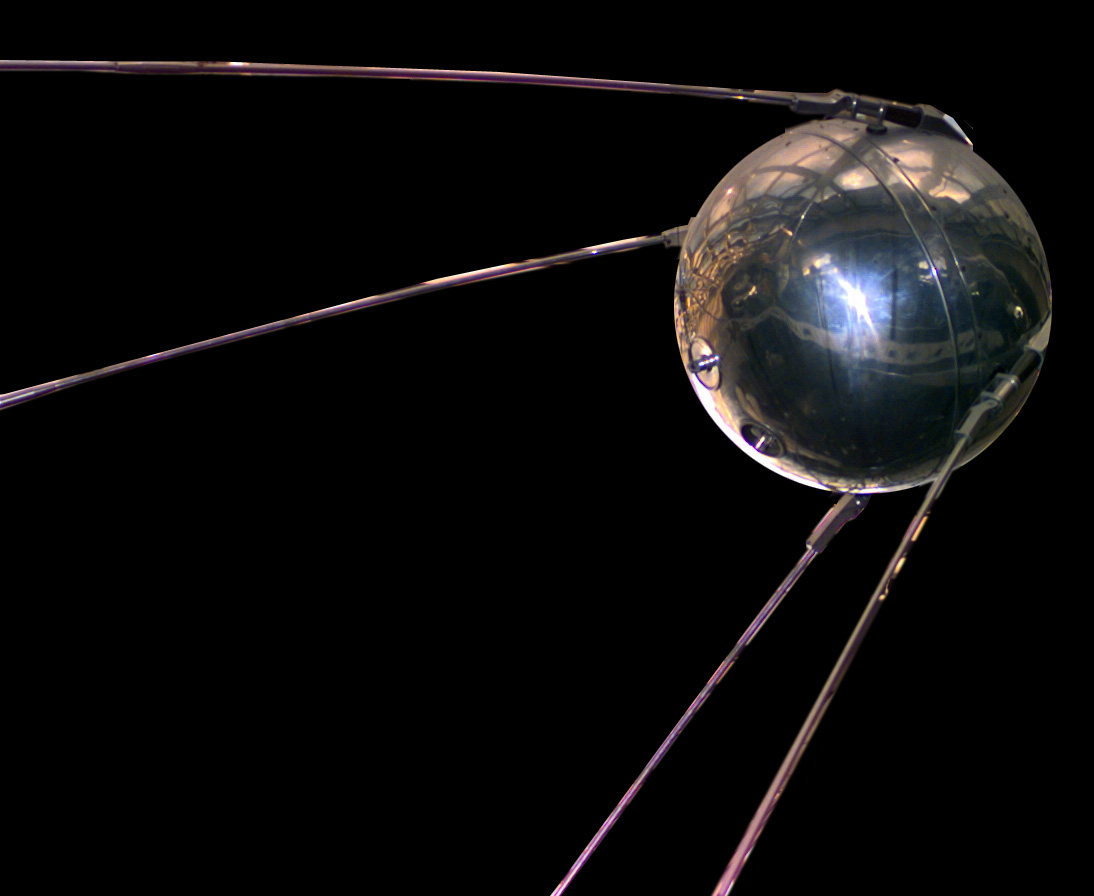
This photograph shows a replica of Sputnik 1, not the flight article, which decayed in 1958. NSSDCA notes that replicas can be seen at museums in Russia and that another is on display at the Smithsonian National Air and Space Museum in Washington, D.C. Credit: NASA/NSSDCA. License: public domain (U.S. government work / NASA). Source: the [NSSDCA image file](https://nssdc.gsfc.nasa.gov/planetary/image/sputnik_asm.jpg), which is the same JPEG (SHA-256 `180df67ea2336459a2512d50d160a58041732b996a3ba3573785ee513ca77349`, 136,665 bytes) as the file on [Wikimedia Commons](https://commons.wikimedia.org/wiki/File:Sputnik_asm.jpg). A Commons administrator reviewed that file on 19 October 2010 and confirmed public-domain status. The JPEG URL above returned HTTP 200 (`image/jpeg`) when checked on 14 November 2026.
## In books and media
Only works checked against a publisher or official page are listed.
- Asif A. Siddiqi, *Challenge to Apollo: The Soviet Union and the Space Race, 1945–1974*, NASA SP-4408, 2000. Official record: [NASA Technical Reports Server](https://ntrs.nasa.gov/citations/20000088626) (work of the U.S. government; public use permitted).
- Asif A. Siddiqi, ["Korolev, Sputnik, and The International Geophysical Year"](https://www.nasa.gov/history/sputnik/siddiqi.html), NASA History.
- Roger D. Launius, ["Sputnik and the Origins of the Space Age"](https://www.nasa.gov/history/sputnik/sputorig.html), NASA History.
- [ESA Euronews: 60 years since Sputnik](https://www.esa.int/media/esa-euronews-60-years-since-sputnik), a 2017 ESA video that includes a visit to RSC Energia's museum and a 1957 Sputnik 1 flight spare.
## See also
[[Solar System Objects]]
[[Earth]]