# Phobos
Phobos is the larger and innermost of Mars' two moons. NASA says it orbits Mars three times a day, so close to the planet that from some locations on Mars it cannot always be seen ([NASA](https://science.nasa.gov/mars/moons/phobos/)). Asaph Hall discovered it on 17 August 1877 and named it, with Deimos, for the mythological sons of Ares; Phobos means fear (NASA).
## Basic facts
From the "Satellites of Mars" table of the NASA/NSSDCA Mars Fact Sheet (last updated 19 May 2025; [NSSDCA](https://nssdc.gsfc.nasa.gov/planetary/factsheet/marsfact.html)): semimajor axis 9,378 km (mean orbital distance from the center of Mars), sidereal orbital and rotation period 0.31891 days, inclination 1.08°, eccentricity 0.0151, mass 10.6 × 10¹⁵ kg, mean density 1,900 kg/m³ and geometric albedo 0.07. Its axis radii are 13.0 km (sub-planetary), 11.4 km (along-orbit) and 9.1 km (polar); NASA gives its dimensions as about 27 × 22 × 18 km ([NASA](https://science.nasa.gov/mars/moons/phobos/)).
The page records a mean radius of 11.05 km, computed here as the geometric mean of the three NSSDCA axis radii, and the semimajor axis as 6.269 × 10⁻⁵ au, converted from kilometres using 1 au = 149,597,870.7 km. The rotation period is the sheet's sidereal rotation period, 0.31891 days × 24 = 7.65384 hours. `moons_count` is 0.
NASA's page describes the largest feature, Stickney crater (about 9 km across), named for Chloe Angeline Stickney Hall, wife of Asaph Hall. It also says Phobos is approaching Mars by about 1.8 meters per century and will either crash into Mars in about 50 million years or break up into a ring, and that it may be a captured asteroid although some evidence contradicts this (NASA).
## Image
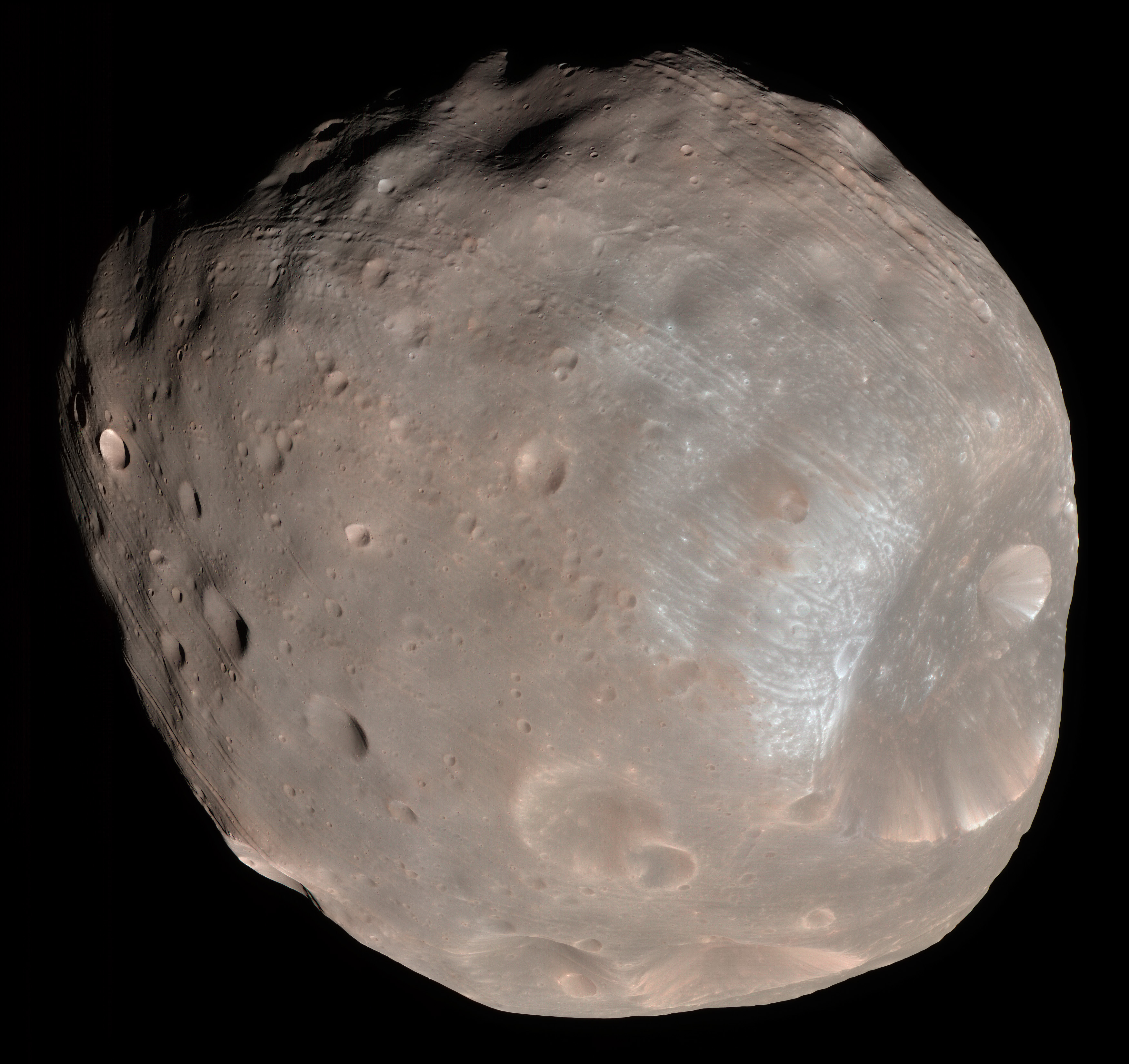
Color image of Phobos taken by the HiRISE camera on NASA's Mars Reconnaissance Orbiter on 23 March 2008 from a distance of about 6,800 km. Credit: NASA/JPL-Caltech/University of Arizona. License: public domain (per Wikimedia Commons). Source: [Wikimedia Commons](https://commons.wikimedia.org/wiki/File:Phobos_colour_2008.jpg).
## Missions and observations
`missions_count` is left empty because no authoritative total was checked; the list below is not claimed to be complete.
- **17 August 1877** — discovery by Asaph Hall ([NASA](https://science.nasa.gov/mars/moons/phobos/)).
- **23 March 2008** — Mars Reconnaissance Orbiter's HiRISE takes the color image above (Wikimedia Commons).
- **March 2010** — Mars Express flies past Phobos at a closest approach of 67 km ([ESA](https://www.esa.int/articles/about-us/directorates/science/mars-express/mars-express-heading-towards-daring-flyby-of-phobos)).
- **29 December 2013** — Mars Express makes its closest flyby, about 45 km above the surface; too close and fast for imaging, it used radio tracking to measure Phobos' gravity field and internal structure (ESA).
- **20 October 2026** — JAXA's Martian Moons eXploration (MMX) launches on an H3 rocket from Tanegashima ([JAXA](https://global.jaxa.jp/press/2026/10/20261020-1_e.html)). According to JAXA's mission site, it is planned to reach the Martian system in 2027, collect about 10 g of Phobos material, depart in 2030 and return the sample capsule to Australia in 2031 ([MMX](https://www.mmx.jaxa.jp/en/)). These later dates are plans, not completed events.
## In books and media
No books, films or documentaries have been verified for this page.
## See also
[[Mars]] · [[Deimos]] · [[Solar System Objects]]