# Mercury
Mercury is the smallest planet in the solar system and the closest planet to the Sun ([NASA Mercury facts](https://science.nasa.gov/mercury/facts/)). It is a terrestrial (rocky) planet with no natural satellites and no ring system ([NSSDCA Mercury Fact Sheet](https://nssdc.gsfc.nasa.gov/planetary/factsheet/mercuryfact.html), last updated 11 January 2024). The same fact sheet lists the discoverer as unknown and the discovery date as prehistoric, so those fields are left empty here.
## Basic facts
Unless noted, the figures in this section are from the NSSDCA Mercury Fact Sheet.
The volumetric mean radius is 2,439.7 km (equatorial radius 2,440.5 km; polar radius 2,438.3 km). The mass is 3.3010 × 10²³ kg (0.33010 × 10²⁴ kg). The mean density is 5,429 kg/m³. Mean surface gravity is 3.70 m/s², and the escape velocity is 4.3 km/s. The Bond albedo is 0.068 and the geometric albedo is 0.142.
The J2000 mean semimajor axis is 0.38709893 au, or 57.909 million km. The sidereal orbital period is 87.969 days; the tropical orbital period is 87.968 days. Perihelion is 46.000 million km and aphelion is 69.818 million km. The orbital eccentricity is 0.2056 and the inclination to the ecliptic is 7.004°. The mean orbital speed is 47.36 km/s, the highest of the eight planets; NASA describes Mercury as the fastest planet, "zipping around the Sun every 88 Earth days."
The sidereal rotation period is 1,407.6 hours. The length of a solar day is 4,222.6 hours. [NASA](https://science.nasa.gov/mercury/facts/) states that Mercury completes one rotation every 59 Earth days and that one Mercury solar day equals 176 Earth days, just over two of Mercury's years. The obliquity to the orbit is 0.034° (NSSDCA).
NASA summarizes dayside surface temperatures as high as 430 °C (800 °F) and nightside temperatures as low as −180 °C (−290 °F), and notes that Venus, not Mercury, is the hottest planet because of Venus's dense atmosphere. Mercury has a thin, surface-bounded exosphere rather than a substantial atmosphere; the fact sheet gives a surface pressure of ≲ 5 × 10⁻¹⁵ bar. [NASA](https://science.nasa.gov/mercury/facts/) lists the exosphere as composed mostly of oxygen, sodium, hydrogen, helium, and potassium.
NASA describes Mercury as the second densest planet after Earth, with a large metallic core about 2,074 km in radius (about 85% of the planet's radius) and an outer shell only about 400 km thick. The surface is heavily cratered. Very large impact basins include Caloris, about 1,550 km across, and Rachmaninoff, about 306 km across ([NASA Mercury facts](https://science.nasa.gov/mercury/facts/)). NASA also reports that water ice may exist at the north and south poles inside permanently shadowed craters.
## Image
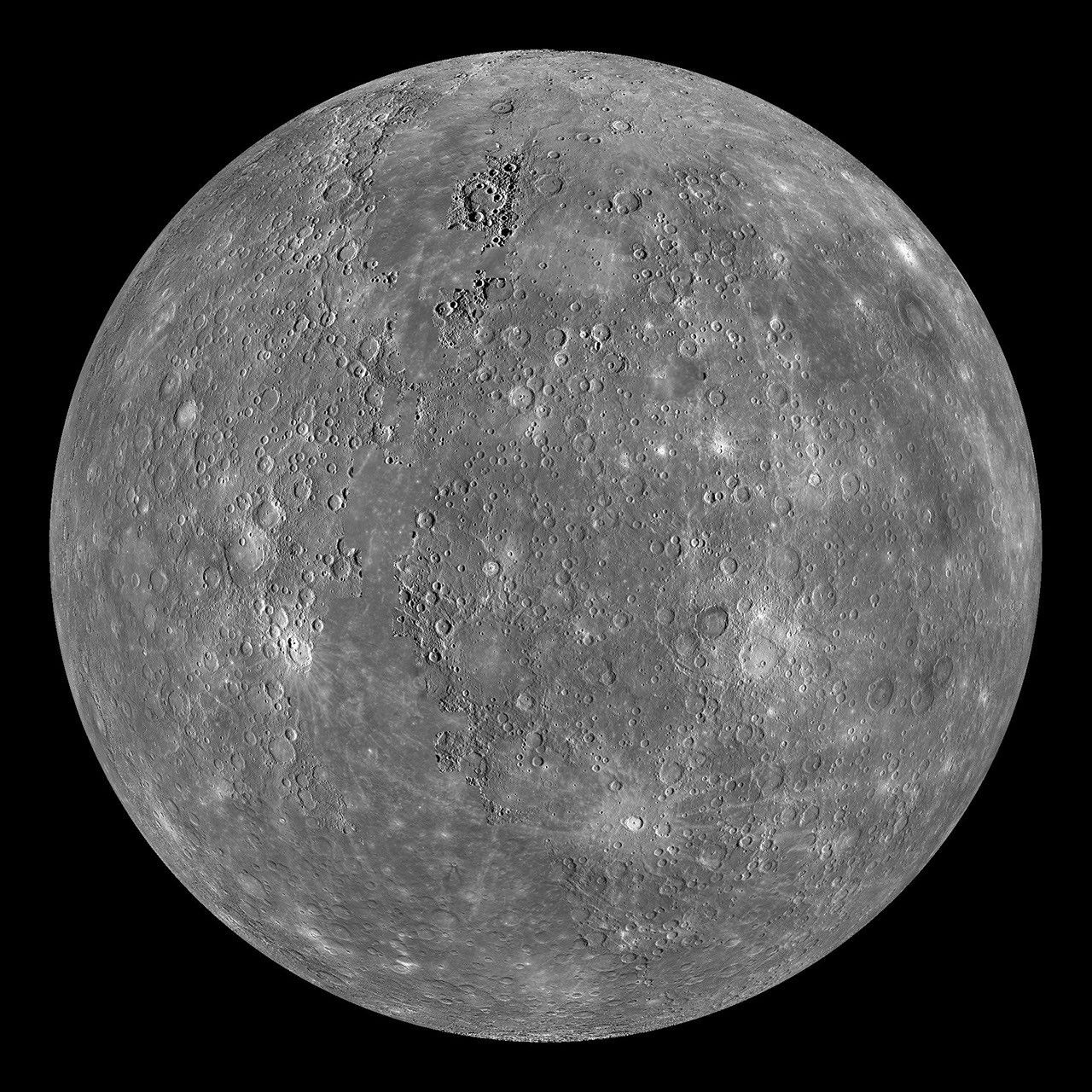
This orthographic projection of a global MESSENGER mosaic is centered at 0°N, 0°E. The rayed crater Debussy is toward the bottom of the globe, and the peak-ring basin Rachmaninoff is toward the eastern edge. Credit: NASA/Johns Hopkins University Applied Physics Laboratory/Carnegie Institution of Washington. License: public domain (NASA). Source: [NASA Photojournal PIA15160](https://science.nasa.gov/photojournal/mercury-globe-0n-0e/), image addition date 29 November 2011. The JPEG URL above returned HTTP 200 (`image/jpeg`) when checked on 13 November 2026.
## Missions and observations
Only three spacecraft have been sent to visit Mercury. That is the `missions_count` used in the frontmatter.
- **Mariner 10** (NASA) — launched 3 November 1973 at 05:45:00 UT. It was the first spacecraft sent to Mercury and the first to use a gravity assist (at Venus) to reach another planet. It took its first image of Mercury on 24 March 1974 and flew by the planet three times: 29 March 1974 (closest approach 703 km at 20:47 UT), 21 September 1974 (about 48,069 km at 20:59 UT), and 16 March 1975 (about 327 km at 22:39 UT) ([NASA Mariner 10](https://science.nasa.gov/mission/mariner-10/)).
- **MESSENGER** (Mercury Surface, Space Environment, Geochemistry, and Ranging; NASA) — the first spacecraft to orbit Mercury. It launched on 3 August 2004 at 06:15:56 UT, flew by Mercury on 14 January 2008, 6 October 2008, and 29 September 2009, and entered orbit with a 15-minute burn starting at 00:45 UT on 18 March 2011. Science observations from orbit began on 4 April 2011 at 20:40 UT. The spacecraft impacted Mercury as planned on 30 April 2015 at 19:26 UT ([NSSDCA MESSENGER](https://nssdc.gsfc.nasa.gov/nmc/spacecraft/display.action?id=2004-030A); [NASA MESSENGER](https://science.nasa.gov/mission/messenger/)). Among the results, NASA reports that the mission verified that Mercury's polar deposits are dominantly water ice.
- **BepiColombo** (ESA/JAXA, with a NASA instrument contribution) — launched 20 October 2018 at 01:45:28 UT from Kourou. It consists of ESA's Mercury Planetary Orbiter (MPO) and JAXA's Mercury Magnetospheric Orbiter (Mio). After cruise flybys, including the first Mercury flyby on 1 October 2021, the Mercury Transfer Module separated from the stack on 3 September 2026. ESA's arrival page, updated 6 October 2026, gives Mercury orbit insertion as 21 November 2026, MPO–Mio separation on 9–10 December 2026, and the start of the science phase in April 2027 ([NASA BepiColombo](https://science.nasa.gov/mission/bepicolombo/); [ESA, Latest updates: BepiColombo's arrival at Mercury](https://www.esa.int/Science_Exploration/Space_Science/BepiColombo/Latest_updates_BepiColombo_s_arrival_at_Mercury)).
## In books and media
Only works checked against a publisher or official page are listed.
- Sean C. Solomon, Larry R. Nittler, and Brian J. Anderson, eds., *Mercury: The View after MESSENGER*, Cambridge University Press, published 10 December 2018, Cambridge Planetary Science 21. Publisher page: [Cambridge University Press](https://www.cambridge.org/core/books/mercury/3EBD8421DD262A4F021BEA8CBB8A6048).
## See also
[[Solar System Objects]]