# Mars
Mars is the fourth planet from the Sun, a cold, dry terrestrial planet with two small moons, Phobos and Deimos, and no ring system ([NSSDCA Mars Fact Sheet](https://nssdc.gsfc.nasa.gov/planetary/factsheet/marsfact.html)). The same fact sheet lists the discoverer as unknown and the discovery date as prehistoric, so those fields are left empty here.
## Basic facts
Unless noted, the figures in this section are from the NSSDCA Mars Fact Sheet.
The volumetric mean radius is 3,389.5 km (equatorial radius 3,396.2 km; polar radius 3,376.2 km). The sheet gives a core radius of 1,830 km and notes that recent results indicate it may be only 1,650–1,675 km. The mass is 6.4169 × 10²³ kg (0.107 of Earth's) and the mean density is 3,934 kg/m³. Mean surface gravity is 3.73 m/s² and the escape velocity is 5.03 km/s. The Bond albedo is 0.250 and the geometric albedo is 0.170. The topographic range is 30 km.
The J2000 mean semimajor axis is 1.52366231 au, or 227.956 million km. The sidereal orbital period is 686.980 days and the tropical orbital period is 686.972 days. Perihelion is 206.650 million km and aphelion is 249.261 million km. The orbital eccentricity is 0.0935 and the inclination to the ecliptic is 1.848°. The mean orbital speed is 24.08 km/s. The synodic period is 779.94 days.
The sidereal rotation period is 24.6229 hours and the length of a solar day is 24.6597 hours. The obliquity to the orbit is 25.19°. At closest, Mars is 54.6 million km from Earth; at greatest distance, 401.4 million km. The maximum apparent visual magnitude is −2.94.
The atmosphere is thin. Mean surface pressure is 6.36 mb, varying from 4.0 to 8.7 mb with the seasons. The average temperature is about 214 K (−59 °C), and at the Viking 1 lander site the diurnal range was 184 K to 242 K (−89 to −31 °C). By volume the atmosphere is 95.1% carbon dioxide, 2.59% nitrogen, 1.94% argon, 0.16% oxygen, and 0.06% carbon monoxide.
The sheet lists the satellites Phobos and Deimos with semimajor axes of 9,378 km and 23,459 km and orbital periods of 0.31891 and 1.26244 days. The mass of Phobos is 10.6 × 10¹⁵ kg and that of Deimos is 2.4 × 10¹⁵ kg.
## Image
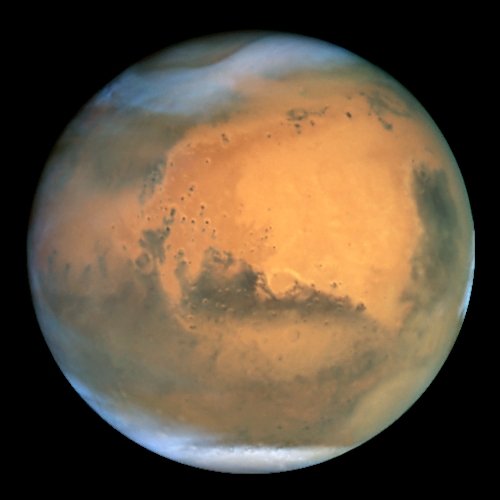
NASA's Hubble Space Telescope took this picture of Mars on 26 June 2001, when the planet was about 68 million km from Earth, the closest approach since 1988. Hubble can see details as small as 16 km across, and the image shows extensive seasonal dust-storm activity. Credit: NASA and The Hubble Heritage Team (STScI/AURA). License: public domain (NASA). Source: [Wikimedia Commons](https://commons.wikimedia.org/wiki/File:Mars_Hubble.jpg). The JPEG URL above returned HTTP 200 (`image/jpeg`) when checked on 14 November 2026.
## Missions and observations
Mars has been visited by many spacecraft. This section covers six milestone NASA missions and is not a complete list; for that reason `missions_count` is left empty.
- **Mariner 4** (NASA) — launched 28 November 1964. It made the first successful flyby of Mars on 14–15 July 1965, with closest approach of 9,846 km at 01:00:57 UT on 15 July, and returned the first pictures of the martian surface ([NSSDCA Mariner 4](https://nssdc.gsfc.nasa.gov/nmc/spacecraft/display.action?id=1964-077A)).
- **Viking 1 and Viking 2** (NASA) — launched 20 August and 9 September 1975, each an orbiter and lander pair. The Viking 1 orbiter entered Mars orbit on 19 June 1976. The Viking 1 lander separated on 20 July 1976 and soft-landed at Chryse Planitia at 11:56:06 UT. The orbiter primary mission ended with solar conjunction on 5 November 1976 ([NSSDCA Viking 1](https://nssdc.gsfc.nasa.gov/nmc/spacecraft/display.action?id=1975-075A)).
- **Mars Global Surveyor** (NASA) — launched 7 November 1996 and captured into orbit at 01:17 UT on 12 September 1997. After aerobraking ended in February 1999 it was in a circular polar mapping orbit with an index altitude of 378 km. Extended missions continued until contact was lost on 2 November 2006 ([NSSDCA Mars Global Surveyor](https://nssdc.gsfc.nasa.gov/nmc/spacecraft/display.action?id=1996-062A)).
- **Mars Reconnaissance Orbiter** (NASA) — launched 12 August 2005 and inserted into Mars orbit on 10 March 2006. Its science operations began in November 2006 ([NSSDCA Mars Reconnaissance Orbiter](https://nssdc.gsfc.nasa.gov/nmc/spacecraft/display.action?id=2005-029A)). NSSDCA's entry says operations continued as of September 2015.
- **Mars Science Laboratory (Curiosity)** (NASA) — launched 26 November 2011, with touchdown in Gale Crater at 05:32 UTC on 6 August 2012 and its first drive on 22 August 2012 ([NSSDCA Mars Science Laboratory](https://nssdc.gsfc.nasa.gov/nmc/spacecraft/display.action?id=2011-070A)).
- **Mars 2020 (Perseverance and Ingenuity)** (NASA) — launched 30 July 2020, with landing on 18 February 2021 at 20:55 UT. The Ingenuity helicopter lost contact just before landing during a flight on 18 January 2024, dropped about 1 m, and damaged its rotors so that it could no longer fly ([NSSDCA Mars 2020](https://nssdc.gsfc.nasa.gov/nmc/spacecraft/display.action?id=2020-052A)).
## In books and media
Only works checked against a publisher or official page are listed.
- Alfred S. McEwen, Candice Hansen-Koharcheck, and Ari Espinoza, *Mars: The Pristine Beauty of the Red Planet*, University of Arizona Press, June 2017, 448 pages, a collection of HiRISE high-resolution color images. Publisher page: [University of Arizona Press](https://uapress.arizona.edu/book/mars).
## See also
[[Solar System Objects]]