# Makemake
Makemake (136472 Makemake, provisional designation 2005 FY9) is a trans-Neptunian dwarf planet in the Kuiper belt. The JPL Small-Body Database credits its discovery on 31 March 2005 at Palomar to M. E. Brown, C. A. Trujillo and D. L. Rabinowitz, and records that it is named for the creator god of the Rapa Nui (Easter Island) people ([JPL SBDB](https://ssd.jpl.nasa.gov/tools/sbdb_lookup.html#/?sstr=136472)). NASA adds that it is the second-brightest object in the Kuiper belt as seen from Earth after Pluto, and that its discovery, along with Eris, helped prompt the IAU to define dwarf planets ([NASA](https://science.nasa.gov/dwarf-planets/makemake/)).
## Basic facts
Orbital elements are from the JPL Small-Body Database (SBDB API, queried 18 November 2026), osculating at epoch JD 2461200.5: semimajor axis 45.57093 au, eccentricity 0.15889, inclination 29.028°, perihelion 38.330 au, aphelion 52.812 au, and orbital period 112,364.81 days (about 308 years). The absolute magnitude H is −0.25.
A stellar occultation on 23 April 2011 was reanalyzed by Brown (2013), who found a spherical-fit diameter of 1,430 ± 7 km; the mean radius recorded here, 715 km, is half that value. The same paper finds the earlier claims of a strongly non-spherical shape to be unjustified ([Brown 2013, *Astrophysical Journal Letters*](https://arxiv.org/abs/1304.1041)). NASA's rounded diameter is about 1,430 km ([NASA](https://science.nasa.gov/dwarf-planets/makemake/)).
The mass is left empty. The satellite's orbit was too poorly constrained at discovery to measure the system mass ([Parker et al. 2016](https://arxiv.org/abs/1604.07461)), and no mass value was verified for this page.
The rotation period of 22.8266 hours is the value SBDB lists from the Asteroid Lightcurve Database (Warner et al. 2009) ([JPL SBDB](https://ssd.jpl.nasa.gov/tools/sbdb_lookup.html#/?sstr=136472)); it was not independently checked here.
Makemake has one known satellite, provisionally S/2015 (136472) 1 (nickname MK 2), detected in Hubble Wide Field Camera 3 imaging on 27 April 2015 ([Parker et al. 2016](https://arxiv.org/abs/1604.07461)).
## Image
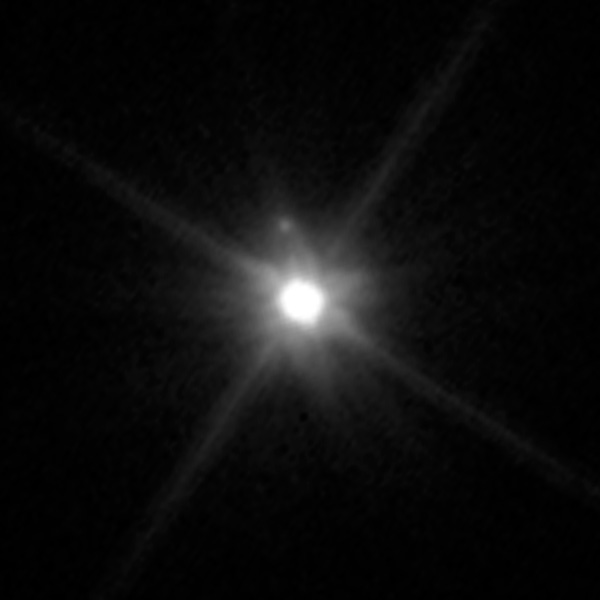
Dwarf planet Makemake and its moon S/2015 (136472) 1 as seen by the Hubble Space Telescope. Credit: NASA, ESA, A. Parker and M. Buie (Southwest Research Institute), W. Grundy (Lowell Observatory) and K. Noll (NASA GSFC). License: public domain (per Wikimedia Commons). Source: [Wikimedia Commons](https://commons.wikimedia.org/wiki/File:Makemake_moon_Hubble_image_only.jpg).
## Missions and observations
`missions_count` is left empty; no spacecraft mission to Makemake is documented in the sources used for this page.
- **Discovery** — Palomar, 31 March 2005 ([JPL SBDB](https://ssd.jpl.nasa.gov/tools/sbdb_lookup.html#/?sstr=136472)).
- **Stellar occultation** — 23 April 2011 ([Brown 2013](https://arxiv.org/abs/1304.1041)).
- **Satellite detection** — Hubble, 27 April 2015 ([Parker et al. 2016](https://arxiv.org/abs/1604.07461)).
## In books and media
Only works checked against a publisher or catalog page are listed.
- Mike Brown, *How I Killed Pluto and Why It Had It Coming*, Spiegel & Grau, 2010. Brown co-discovered Makemake. Catalog record: [Open Library](https://openlibrary.org/works/OL15550776W).
## See also
[[Solar System Objects]]