# Io
Io is the innermost of Jupiter's four Galilean moons. NASA credits Galileo Galilei with discovering four moons orbiting Jupiter in 1610 ([NASA](https://science.nasa.gov/moon/facts/)). NASA calls Io the most volcanically active world in the solar system, with hundreds of volcanoes, some erupting lava fountains dozens of kilometres high, and notes that it is only slightly larger than Earth's Moon ([NASA](https://science.nasa.gov/jupiter/moons/io/)).
## Basic facts
From the NASA/NSSDCA Jovian Satellite Fact Sheet (last updated 6 December 2023; [NSSDCA](https://nssdc.gsfc.nasa.gov/planetary/factsheet/joviansatfact.html)): mass 893.2 × 10²⁰ kg (8.932 × 10²² kg), radius 1,821.5 km, mean density 3,530 kg/m³, and visual geometric albedo 0.62.
Io orbits Jupiter at a semimajor axis of 421.8 × 10³ km (5.91 Jovian radii) with a period of 1.769138 days, an eccentricity of 0.004 and an inclination of 0.04° (NSSDCA). The page records the semimajor axis as 0.00282 au, converted from kilometres using 1 au = 149,597,870.7 km. Rotation is synchronous, so the rotation period is recorded as the orbital period, 42.4593 hours (1.769138 days × 24).
NASA describes Io as caught between Jupiter's gravity and the precisely timed pulls of Europa and Ganymede, which drives its volcanism ([NASA](https://science.nasa.gov/jupiter/moons/io/)).
## Image
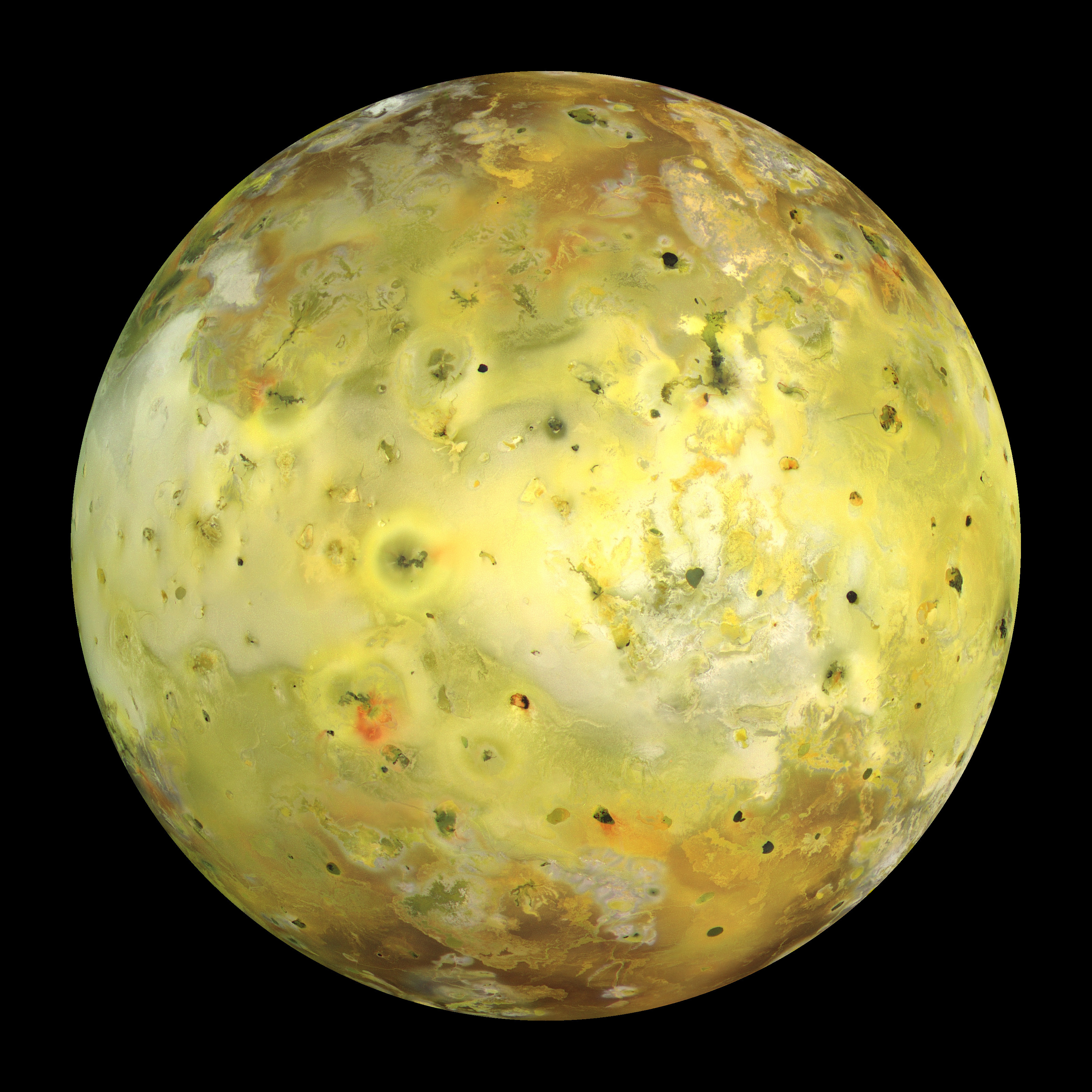
Color mosaic of Io from Galileo's highest-resolution images, acquired on 3 July 1999, approximating what the human eye would see. Credit: NASA/JPL/University of Arizona. License: public domain (per Wikimedia Commons). Source: [Wikimedia Commons](https://commons.wikimedia.org/wiki/File:Io_highest_resolution_true_color.jpg).
## Missions and observations
`missions_count` is left empty; NASA does not give a single total for Io. From NASA's Io page ([NASA](https://science.nasa.gov/jupiter/moons/io/)):
- **1979** — Voyager 1 spots the first signs of Io's powerful volcanism.
- **Galileo** — most of what is known comes from the Galileo spacecraft's study of the Jupiter system; the highest-resolution Galileo images were taken on 3 July 1999.
- **Since 2003** — Ulysses, Cassini, New Horizons and Juno make additional close observations.
- **30 December 2023** — Juno images Io during a close approach.
## In books and media
No books, films or documentaries have been verified for this page.
## See also
[[Jupiter]] · [[Europa]] · [[Solar System Objects]]