# Haumea
Haumea (136108 Haumea, provisional designation 2003 EL61) is a trans-Neptunian dwarf planet in the Kuiper belt, noted for its elongated shape and very fast rotation. The JPL Small-Body Database credits its discovery on 7 March 2003 at the Sierra Nevada Observatory to F. J. Aceituno, P. Santos-Sanz and J. L. Ortiz, and records that it is named for the Hawaiian goddess of childbirth and fertility ([JPL SBDB](https://ssd.jpl.nasa.gov/tools/sbdb_lookup.html#/?sstr=136108)). NASA notes that two teams claim credit for the discovery, citing observations from 2003 and 2004, and that the IAU Gazetteer lists no official discoverer ([NASA](https://science.nasa.gov/dwarf-planets/haumea/)). The discoverer list above follows the JPL credit.
## Basic facts
Orbital elements are from the JPL Small-Body Database (SBDB API, queried 18 November 2026), osculating at epoch JD 2461200.5: semimajor axis 43.06029 au, eccentricity 0.19444, inclination 28.208°, perihelion 34.688 au, aphelion 51.433 au, and orbital period 103,208.12 days (about 283 years). The absolute magnitude H is 0.14.
A stellar occultation observed on 21 January 2017 from twelve sites gave semi-axes for a triaxial ellipsoid of about 1,161 ± 30 km (longest) and 852 km, with a volume-equivalent diameter of 1,595 ± 11 km; the mean radius recorded here, 797.5 km, is half that volume-equivalent diameter ([Ortiz et al. 2017, *Nature* 550, 219](https://doi.org/10.1038/nature24051); [arXiv version](https://arxiv.org/abs/2006.03113)). NASA's rounded equatorial diameter is about 1,740 km ([NASA](https://science.nasa.gov/dwarf-planets/haumea/)).
The mass is 4.006 × 10²¹ kg, from the fully interacting orbit solution for Haumea's satellites using Hubble and Keck astrometry ([Ragozzine and Brown 2009, *Astronomical Journal* 137, 4766](https://arxiv.org/abs/0903.4213)).
The rotation period is 3.9154 hours, from the Asteroid Lightcurve Database as listed in SBDB ([JPL SBDB](https://ssd.jpl.nasa.gov/tools/sbdb_lookup.html#/?sstr=136108)). NASA describes Haumea as one of the fastest-rotating large objects in the solar system, its spin giving it a football-like shape ([NASA](https://science.nasa.gov/dwarf-planets/haumea/)).
Haumea has two known satellites, Hiʻiaka (discovered 26 January 2005) and Namaka (discovered 7 November 2005), found by M. E. Brown, A. H. Bouchez and the Keck adaptive optics teams ([JPL SBDB](https://ssd.jpl.nasa.gov/tools/sbdb_lookup.html#/?sstr=136108)). The 2017 occultation also revealed a ring of opacity 0.5, width about 70 km and radius about 2,287 km ([Ortiz et al. 2017](https://doi.org/10.1038/nature24051)).
## Image
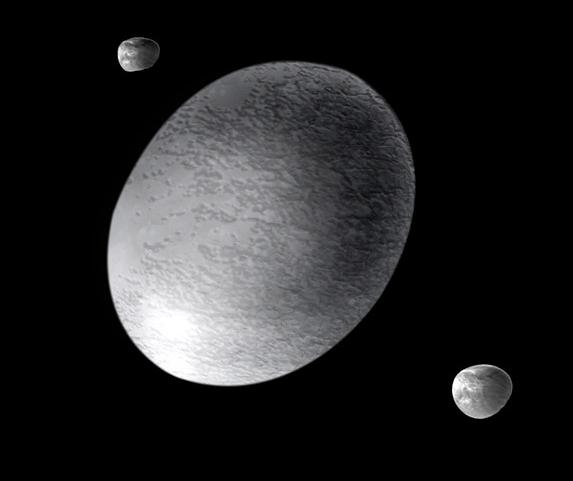
Artist's impression of Haumea and its two moons. Credit: A. Feild (Space Telescope Science Institute). License: public domain (per Wikimedia Commons). Source: [Wikimedia Commons](https://commons.wikimedia.org/wiki/File:2003EL61art.jpg).
## Missions and observations
`missions_count` is left empty; no spacecraft mission to Haumea is documented in the sources used for this page.
- **Discovery** — Sierra Nevada Observatory, 7 March 2003 ([JPL SBDB](https://ssd.jpl.nasa.gov/tools/sbdb_lookup.html#/?sstr=136108)).
- **Satellite discoveries** — Hiʻiaka 26 January 2005; Namaka 7 November 2005 ([JPL SBDB](https://ssd.jpl.nasa.gov/tools/sbdb_lookup.html#/?sstr=136108)).
- **Stellar occultation** — 21 January 2017, revealing the shape and ring ([Ortiz et al. 2017](https://doi.org/10.1038/nature24051)).
## In books and media
No books, films or documentaries have been verified for this page.
## See also
[[Solar System Objects]]