# Enceladus
Enceladus is a small, icy moon of Saturn with geyser-like jets that spray water vapor and ice particles into space. NASA says it has the most reflective surface in the solar system, and that its plumes feed Saturn's E ring ([NASA](https://science.nasa.gov/saturn/moons/enceladus/)). William Herschel spotted it on 28 August 1789 (NASA).
## Basic facts
From the NASA/NSSDCA Saturnian Satellite Fact Sheet ([NSSDCA](https://nssdc.gsfc.nasa.gov/planetary/factsheet/saturniansatfact.html)): mass 1.08 × 10²⁰ kg, triaxial radii of 257 × 251 × 248 km, mean density 1,610 kg/m³ and visual geometric albedo 1.0. No mean radius is given on the sheet, so `mean_radius_km` is left empty. It orbits Saturn at a semimajor axis of 238.02 × 10³ km (3.9494 Saturn radii) with a period of 1.370218 days, eccentricity 0.0045 and inclination 0.00°; the sheet marks its rotation as synchronous. NASA reports a surface temperature of about −201 °C and a south-polar ice shell perhaps 1 to 5 km thick ([NASA](https://science.nasa.gov/saturn/moons/enceladus/)). The page records the semimajor axis in au, converted from kilometres using 1 au = 149,597,870.7 km, and the rotation period as the orbital period × 24 (32.88523 hours) because the rotation is synchronous.
## Image
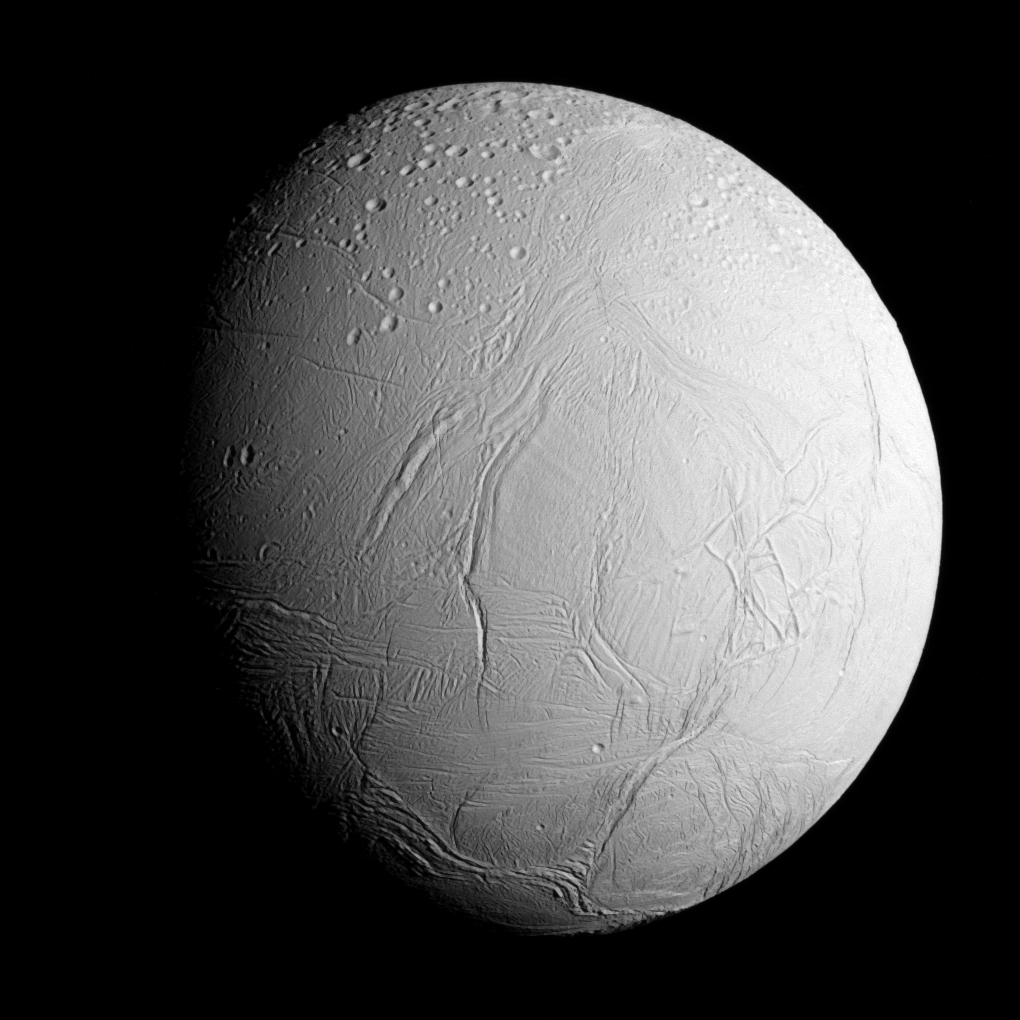
Cassini's view of Enceladus as it approached for its closest-ever dive past the active south polar region. Credit: NASA/JPL-Caltech. License: Public domain (NASA/JPL) (per Wikimedia Commons). Source: [Wikimedia Commons](https://commons.wikimedia.org/wiki/File:PIA17202_-_Approaching_Enceladus.jpg).
## Missions and observations
`missions_count` is left empty because no authoritative total was checked; the list below is not claimed to be complete.
- **Voyager** — 1980s images showed a small, smooth, bright white world ([NASA](https://science.nasa.gov/saturn/moons/enceladus/)).
- **Cassini** — discovered the water-and-gas plumes in 2005 (NASA).
- **Cassini flyby, 9 October 2008** — passed within about 25 km (16 miles) of the surface (NASA).
- **Cassini image, 30 November 2010** — captured the plume jets with Enceladus's shadow across them (NASA).
## In books and media
No books, films or documentaries have been verified for this page.
## See also
[[Saturn]] · [[Titan]] · [[Solar System Objects]]