# Earth
Earth is the third planet from the Sun, counting outward from Mercury and Venus. It is a terrestrial planet with one natural satellite, the Moon, and no ring system ([NSSDCA Earth Fact Sheet](https://nssdc.gsfc.nasa.gov/planetary/factsheet/earthfact.html), last updated 15 November 2024). Discoverer and discovery year are left empty because Earth has no discovery event.
## Basic facts
Unless noted, the figures in this section are from the NSSDCA Earth Fact Sheet.
The volumetric mean radius is 6,371.000 km (equatorial radius 6,378.137 km; polar radius 6,356.752 km; core radius 3,485 km). The mass is 5.9722 × 10²⁴ kg and the mean density is 5,513 kg/m³. Mean surface gravity is 9.820 m/s²; the standard acceleration of gravity is defined as 9.80665 m/s² (CODATA 2018). The escape velocity is 11.186 km/s. The Bond albedo is 0.294 and the geometric albedo is 0.434.
The J2000 mean semimajor axis is 1.00000011 au, or 149.598 million km. The sidereal orbital period is 365.256 days and the tropical orbital period is 365.242 days. Perihelion is 147.095 million km and aphelion is 152.100 million km. The orbital eccentricity is 0.0167. The mean orbital speed is 29.78 km/s.
The sidereal rotation period is 23.9345 hours, and the length of a solar day is 24.0000 hours. The obliquity to the orbit is 23.44°.
The sheet lists a surface pressure of 1,014 mb and an average temperature of 288 K (15 °C). Dry air is 78.08% nitrogen and 20.95% oxygen by volume, with argon at 9,340 ppm and carbon dioxide at 420 ppm; water is highly variable and typically about 1%. The total mass of the atmosphere is about 5.1 × 10¹⁸ kg and the total mass of the hydrosphere is about 1.4 × 10²¹ kg. The fact sheet also describes a terrestrial magnetosphere with a dipole field strength of 0.306 gauss-Re³.
The Moon is Earth's only natural satellite. NASA's moons page counts it as one of 461 officially recognized planetary moons across the solar system as of October 2026 ([NASA Moons: Facts](https://science.nasa.gov/solar-system/moons/facts/)).
## Image
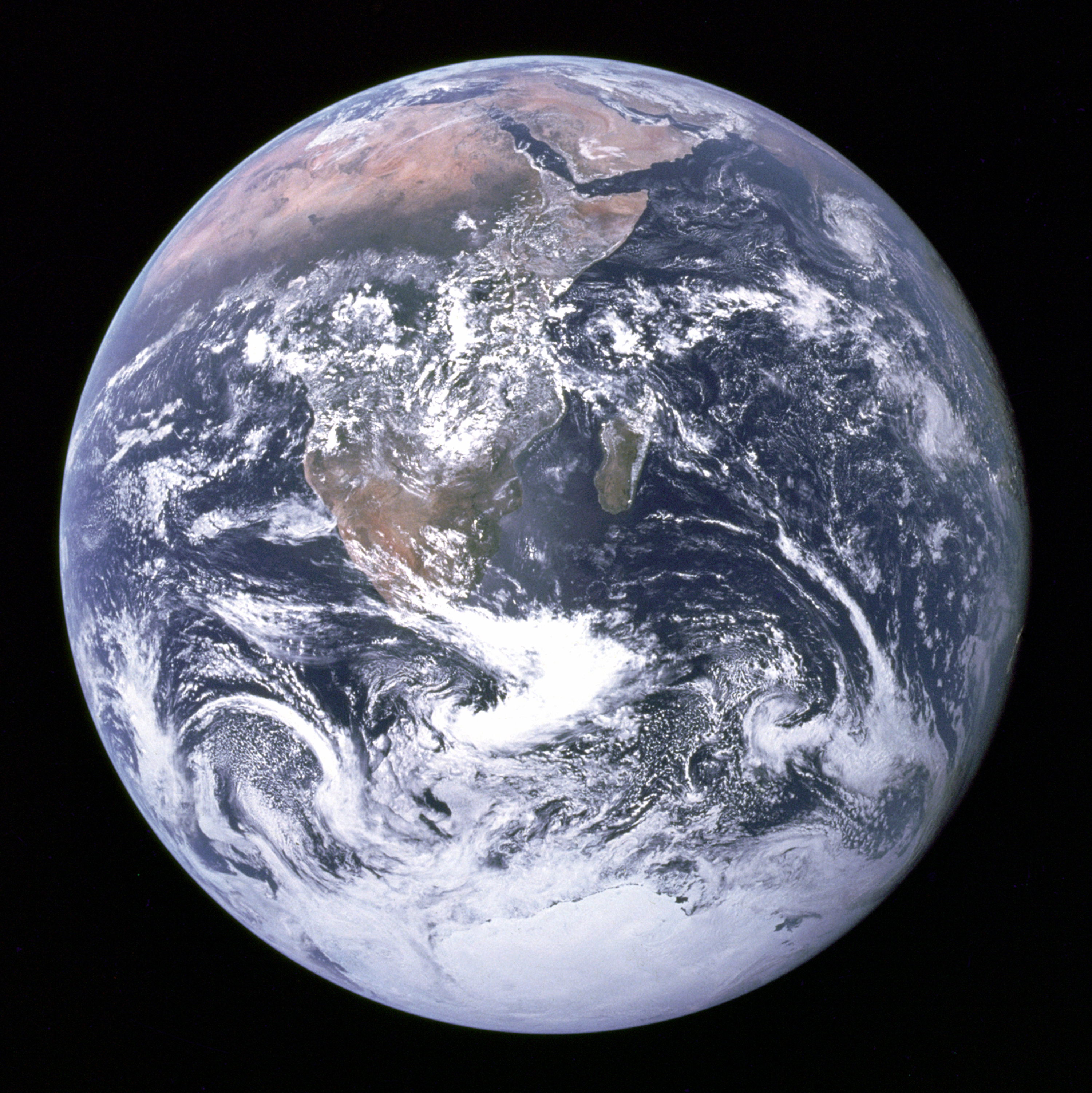
"The Blue Marble" was taken on 7 December 1972 by the crew of Apollo 17 while en route to the Moon, at a distance of about 29,400 km. It shows Africa, Antarctica, and the Arabian Peninsula. Credit: NASA/Apollo 17 crew (taken by Harrison Schmitt or Ron Evans, per Commons). License: public domain (NASA). Source: [Wikimedia Commons](https://commons.wikimedia.org/wiki/File:The_Earth_seen_from_Apollo_17.jpg). The JPEG URL above returned HTTP 200 (`image/jpeg`) when checked on 14 November 2026.
## Missions and observations
Earth is observed by a very large number of satellites, so no complete count is attempted and `missions_count` is left empty. Three milestone NASA Earth-observing missions are described here.
- **[[Sputnik 1]]** (OKB-1 / USSR) — the first artificial Earth satellite, launched 4 October 1957 from Tyuratam (Baikonur Cosmodrome). It is not still in orbit: the satellite reentered on 4 January 1958, and the R-7 core stage reentered on 1 December 1957.
- **TIROS 1** (Television and InfraRed Observation Satellite; NASA) — launched 1 April 1960 on a Thor from Cape Canaveral. It was the first weather satellite, built to test whether television cloud-cover pictures from orbit were useful. It performed normally until an electrical power failure on 15 June 1960 ended useful TV transmission ([NSSDCA TIROS 1](https://nssdc.gsfc.nasa.gov/nmc/spacecraft/display.action?id=1960-002B)).
- **Landsat 1** (formerly ERTS-1; NASA) — launched 23 July 1972. It carried a multispectral scanner and a return beam vidicon camera system to image agriculture, forestry, geology, hydrology, and oceanography and marine resources. It was turned off on 6 January 1978 after orbital precession exposed it to near-constant sunlight and overheating ([NSSDCA Landsat 1](https://nssdc.gsfc.nasa.gov/nmc/spacecraft/display.action?id=1972-058A)).
- **Terra** (formerly EOS-AM1; NASA) — launched 18 December 1999 on an Atlas II AS from Vandenberg. Its instruments are ASTER, CERES, MISR, MODIS, and MOPITT, supporting study of Earth's land, atmosphere, oceans, and biology ([NSSDCA Terra](https://nssdc.gsfc.nasa.gov/nmc/spacecraft/display.action?id=1999-068A)).
## In books and media
Only works checked against a publisher or official page are listed.
- *Planet Earth* (BBC), Series 1, narrated by David Attenborough: an 11-episode documentary series about the natural world, filmed over four years in 64 countries according to the BBC. Official page: [BBC programmes](https://www.bbc.co.uk/programmes/b006mywy).
## See also
[[Solar System Objects]]