# Dia
Dia (Jupiter LIII, provisionally S/2000 J11) is a tiny prograde irregular moon of Jupiter in the Himalia group. NASA gives it a radius of about 2 km. A team of S. S. Sheppard, D. C. Jewitt, Y. Fernandez and G. Magnier discovered it in 2000 with the University of Hawaii 2.2 m telescope on Mauna Kea; it was then lost for years and was rediscovered in Magellan Telescope images from 2010 and 2011 ([NASA](https://science.nasa.gov/jupiter/jupiter-moons/dia/)). The name means "she who belongs to Zeus" (NASA); Wikipedia gives the naming date as 7 March 2015 ([Wikipedia](https://en.wikipedia.org/wiki/Dia_(moon))).
## Basic facts
From the NASA/NSSDCA Jovian Satellite Fact Sheet (last updated 6 December 2023; [NSSDCA](https://nssdc.gsfc.nasa.gov/planetary/factsheet/joviansatfact.html)): radius 2.0 km, geometric albedo 0.04, semimajor axis 12,118 × 10³ km (169.5 Jovian radii), orbital period 287.0 days, inclination 28.2° and eccentricity 0.211. The fact sheet gives no mass, so `mass_kg` is empty; no rotation measurement was found, so `rotation_period_hours` is empty. The mean radius of 2 km is NASA's figure ([NASA](https://science.nasa.gov/jupiter/jupiter-moons/dia/)).
NASA lists Dia among the smallest members of the Himalia group, with Himalia, Leda, Lysithea and Elara. The page records the semimajor axis in au, converted from kilometres using 1 au = 149,597,870.7 km. `moons_count` is 0.
## Image
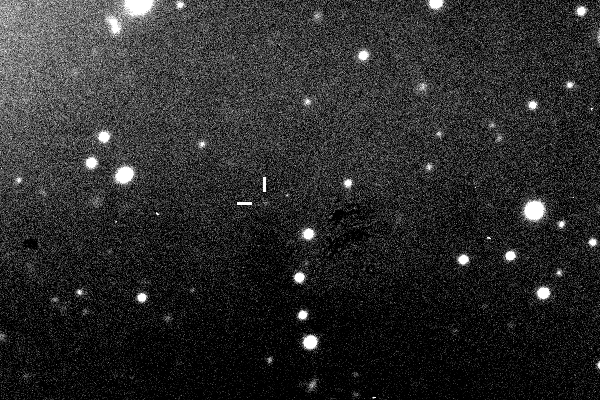
Dia (S/2000 J 11), very faint at apparent magnitude 23.1, imaged by David Jewitt with the 3.6 m Canada-France-Hawaii Telescope on 9 December 2001. Credit: David Jewitt / Canadian Astronomy Data Centre. License: CC BY-SA 4.0 (per Wikimedia Commons). Source: [Wikimedia Commons](https://commons.wikimedia.org/wiki/File:Dia-Jewitt-CFHT_image-crop.png).
## Missions and observations
`missions_count` is left empty because no authoritative total was checked; the list below is not claimed to be complete.
- **2000** — discovered by Sheppard, Jewitt, Fernandez and Magnier on Mauna Kea ([NASA](https://science.nasa.gov/jupiter/jupiter-moons/dia/)).
- **9 December 2001** — imaged with the Canada-France-Hawaii Telescope (per the Commons file description).
- **2010–2011** — rediscovered in Magellan Telescope images (NASA); the Minor Planet Center published the recovery in [MPEC 2012-R22](https://www.minorplanetcenter.net/mpec/K12/K12R22.html) in September 2012.
- **7 March 2015** — named Dia ([Wikipedia](https://en.wikipedia.org/wiki/Dia_(moon))).
No dedicated spacecraft visit was verified.
## In books and media
No books, films or documentaries have been verified for this page.
## See also
[[Jupiter]] · [[Himalia]] · [[Leda]] · [[Solar System Objects]]