# Ceres
Ceres is the largest object in the asteroid belt between Mars and Jupiter and the only dwarf planet in the inner solar system. It was the first asteroid-belt member discovered, by Giuseppe Piazzi in 1801, and when NASA's Dawn arrived in 2015 it became the first dwarf planet to be visited by a spacecraft ([NASA Ceres facts](https://science.nasa.gov/dwarf-planets/ceres/facts/)). The JPL Small-Body Database records the discovery at Palermo and gives the designation 1 Ceres (A801 AA) ([JPL SBDB](https://ssd.jpl.nasa.gov/tools/sbdb_lookup.html#/?sstr=1)).
## Basic facts
Unless noted, the figures in this section are from the JPL Small-Body Database (SBDB API, queried 15 November 2026).
The mean diameter is 939.4 ± 0.2 km, so the mean radius is 469.7 km (derived by halving the diameter); the triaxial extent is 964.4 × 964.2 × 891.8 km. These shape values and the gravitational parameter GM = 62.6284 ± 0.0009 km³/s² come from Dawn results in *Nature* vol. 537, pp. 515–517 (22 September 2016), as cited by SBDB. The mass of about 9.3839 × 10²⁰ kg is derived here by dividing GM by the gravitational constant G = 6.6743 × 10⁻²⁰ km³ kg⁻¹ s⁻²; it is not a value published by SBDB. The mean density is 2.162 ± 0.008 g/cm³ and the geometric albedo is 0.090 ± 0.003 (Li et al. 2006, *Icarus* 182, 143–160).
The osculating elements are given at the SBDB epoch JD 2461200.5: semimajor axis 2.765553 au, eccentricity 0.07969, inclination 10.588°, perihelion 2.545 au, aphelion 2.986 au, and orbital period 1,679.853 days (about 4.6 years). The rotation period is 9.07417 hours. The absolute magnitude H is 3.34 and the spectral type is G (Tholen) / C (SMASS).
NASA states that Ceres does not have any moons ([NASA Ceres facts](https://science.nasa.gov/dwarf-planets/ceres/facts/)).
## Image
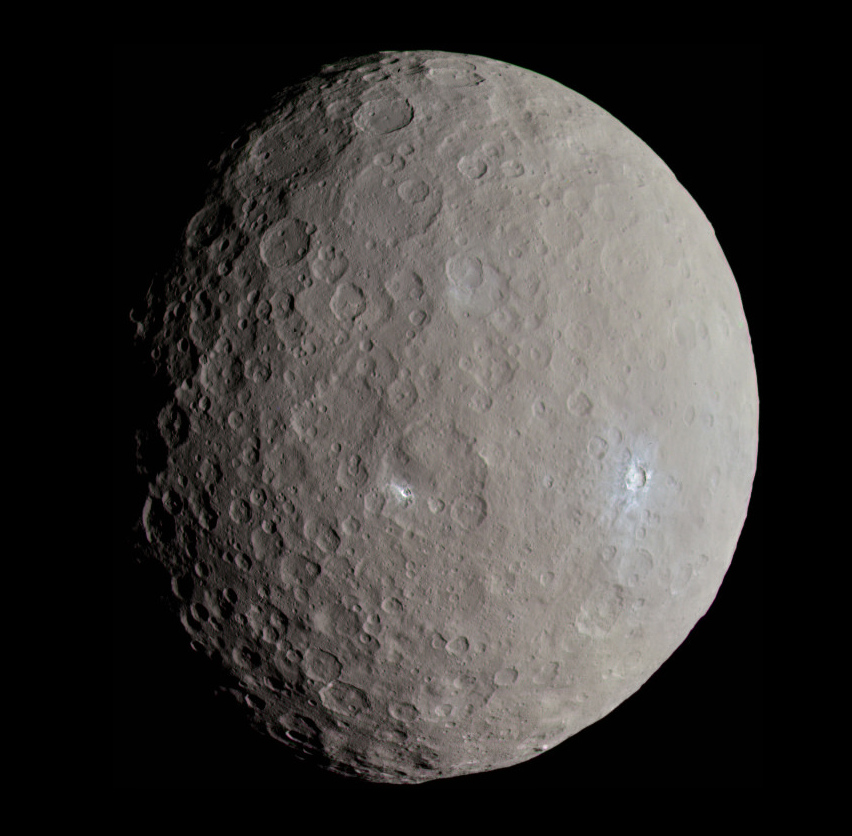
An approximate true-color view of Ceres from Dawn, acquired at 04:13 UT on 4 May 2015 from 13,641 km, with the bright crater Haulani at right. Credit: NASA/JPL-Caltech/UCLA/MPS/DLR/IDA (image processing by Justin Cowart). License: public domain (NASA data, per Wikimedia Commons). Source: [Wikimedia Commons](https://commons.wikimedia.org/wiki/File:Ceres_-_RC3_-_Haulani_Crater_(22381131691)_(cropped).jpg).
## Missions and observations
`missions_count` is left empty because this page lists only the milestone mission.
- **Discovery** — Giuseppe Piazzi, Palermo, 1801 ([JPL SBDB](https://ssd.jpl.nasa.gov/tools/sbdb_lookup.html#/?sstr=1)).
- **Dawn** (NASA) — launched 27 September 2007 from Cape Canaveral. It orbited Vesta from 16 July 2011 to 5 September 2012, then entered orbit around Ceres on 6 March 2015 at 12:29 UT ([NSSDCA Dawn](https://nssdc.gsfc.nasa.gov/nmc/spacecraft/display.action?id=2007-043A); [NASA Dawn](https://science.nasa.gov/mission/dawn/)).
## In books and media
No book, film, or documentary about Ceres was verified against a publisher or official page, so none is listed.
## See also
[[Solar System Objects]]