# Amalthea
Amalthea is the largest of Jupiter's four small inner moons and the third-closest known moon to the planet. NASA notes that it orbits about 181,400 km from Jupiter, inside the orbit of Io, and that it is the source, together with Thebe, of material for the Gossamer ring ([NASA](https://science.nasa.gov/jupiter/jupiter-moons/amalthea/)). Edward Emerson Barnard discovered it on 9 September 1892 with the 36-inch refractor at Lick Observatory; it was the last planetary moon found by direct visual observation, and the first new moon of Jupiter since Galileo's discoveries of 1610 ([Wikipedia](https://en.wikipedia.org/wiki/Amalthea_(moon))). It is named for the nymph who nursed the infant Zeus; the name was suggested by Camille Flammarion and formally adopted by the IAU in 1976 (Wikipedia, NASA).
## Basic facts
From the NASA/NSSDCA Jovian Satellite Fact Sheet (last updated 6 December 2023; [NSSDCA](https://nssdc.gsfc.nasa.gov/planetary/factsheet/joviansatfact.html)): mass 0.075 × 10²⁰ kg (7.5 × 10¹⁸ kg), dimensions listed as 125 × 73 × 64 km, mean density 3100 kg/m³ as tabulated, geometric albedo 0.09, semimajor axis 181.4 × 10³ km (2.54 Jovian radii), orbital period 0.498179 days, inclination 0.38° and eccentricity 0.003; the sheet marks rotation as synchronous. NASA gives a mean radius of about 83.5 ± 2.4 km ([NASA](https://science.nasa.gov/jupiter/jupiter-moons/amalthea/)).
NASA says Amalthea rotates once per orbit, always keeping the same side toward Jupiter, and that its orbit will eventually decay (NASA). It appears to be the reddest object in the Solar System ([NASA](https://science.nasa.gov/jupiter/jupiter-moons/amalthea/)). After the Galileo flyby of 2002, Wikipedia reports a density as low as 0.86 g/cm³, implying a porous or icy body, which conflicts with the older tabulated density; treat the tabulated density with caution. The page records the semimajor axis as 0.001213 au, converted from kilometres using 1 au = 149,597,870.7 km, and the rotation period as the orbital period × 24 (0.498179 days = 11.956296 hours) on the synchronous assumption. `moons_count` is 0.
## Image
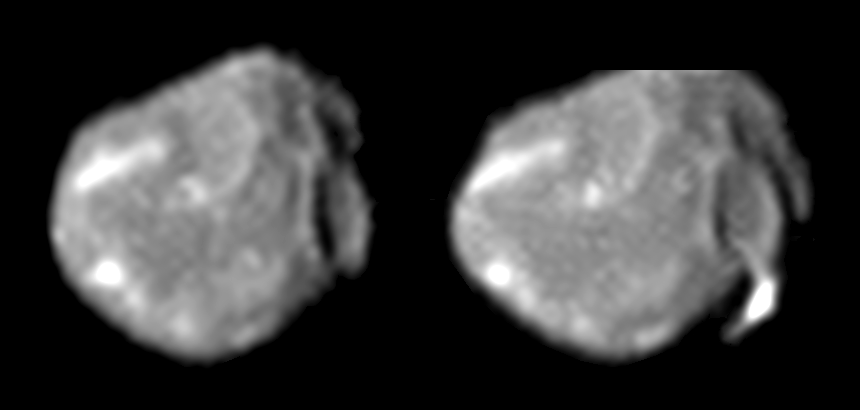
Amalthea as photographed by NASA's Galileo spacecraft on 12 August 1999 (range 446,000 km) and 26 November 1999 (range 374,000 km); JPL Photojournal PIA02532. Credit: NASA/JPL. License: public domain (per Wikimedia Commons). Source: [Wikimedia Commons](https://commons.wikimedia.org/wiki/File:Amalthea_PIA02532.png).
## Missions and observations
`missions_count` is left empty because no authoritative total was checked; the list below is not claimed to be complete.
- **9 September 1892** — discovered visually by E. E. Barnard at Lick Observatory ([Wikipedia](https://en.wikipedia.org/wiki/Amalthea_(moon))).
- **1979** — Voyager 1 and Voyager 2 obtained the first images resolving surface features (Wikipedia).
- **1990s** — the Galileo orbiter completed the imaging of the surface (Wikipedia; [NASA](https://science.nasa.gov/jupiter/jupiter-moons/amalthea/)).
- **5 November 2002** — Galileo's final moon flyby passed about 160 km above the surface; the deflection of its trajectory yielded the moon's mass (Wikipedia).
- **25 April 2027** — Wikipedia states that NASA's Juno is planned to make a close flyby; this is a future event and not independently verified here.
## In books and media
- Arthur C. Clarke, "Jupiter Five", a short story first published in *If* in May 1953 and collected in 1956, is set on Jupiter V, the designation of Amalthea ([Wikipedia](https://en.wikipedia.org/wiki/Jupiter_Five)).
No films or documentaries have been verified for this page.
## See also
[[Jupiter]] · [[Thebe]] · [[Adrastea]] · [[Metis]] · [[Solar System Objects]]